Echoes of Crius
- Platform: PC
- Engine: Unity Engine 2022.3.18f1, Articy Draft X
- Development Time: 1 month
- Team Size: 7
- Developers: May Watkinson, Six other classmates
- My Role(s): Writer, Narrative Designer, System Designer
Echoes of Crius is a short turn-based RPG with splitting story paths and several alternate endings inspired by anime and games from the mecha genre. The game has a dark story with intense details describing the violent mech fights, and the inherent horror of operating a war machine interfaced with your own mind.
My Contributions to this project include:
- Brainstorming the game’s core concept with other members of the team.
- Balanced the equipment the player is given for the limited RPG battle portions of the game.
- Assisted in revising and editing.
- Assisted in playtesting.
- Handling all the writing for multiple large sections of the game.
- Implemented my contributions to the plot and script into Articy:draft, as well as programming the split story pathways.
Designing for Brutality

Out of all the narrative design projects I worked on, Echoes of Crius was by far the most mature in terms of violence and themes, featuring mech combat that does not spare any grisly details, and explores concepts like identity death, betrayal, and body horror.

Because of the level of maturity in this project, it afforded me the chance to be the most descriptive I’ve been in any of my narrative design projects. Because of this, it remains my favorite project in terms of sheer writing.
Not Having Full Control Over the Narrative
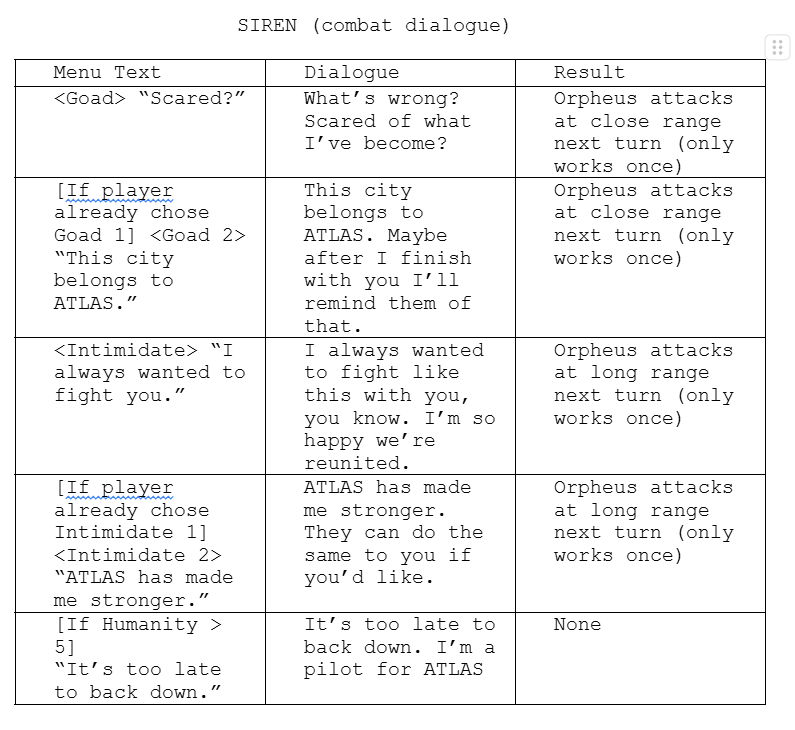
As a project for a narrative design class, every member of the team was meant to have some meaningful contribution to the game’s plot, writing, and gameplay integration. This project taught me how to work with concepts that were not initially my idea. While many elements of the game’s story and the implementation of most story beats were still a group effort, and not a single person’s concept, compromises still needed to be made. Our best way to remedy this “too many cooks in the kitchen” problem was to perform multiple group brainstorming sessions to blueprint an overall plot, as well as concepts for gameplay integration.
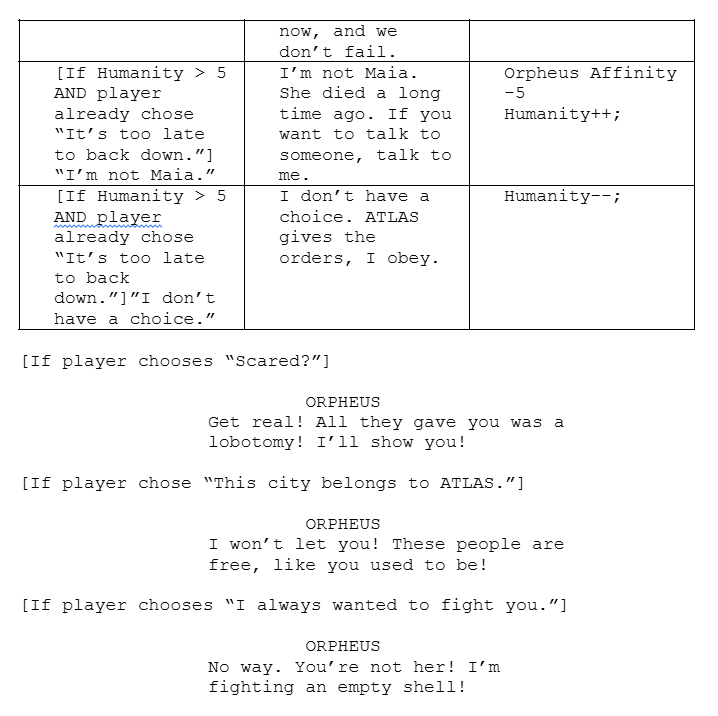
I, as well as another writer on the project were assigned to one of the game’s two possible finales. This provided me the experience in matching the tone of others in a collaborative work, and not getting too involved in my own writing style. While I don’t believe I did this perfectly during this project (see the previous section), this project gave me the experience needed to better match that in the future. Additionally, this gave me a chance to explore how branching dialogue options can be used to make combat more meaningful, and how to weave narrative elements into it diabetically.
 May W. Games