Flash-Blade Renegade
- Platform: PC
- Engine: Unreal Engine 5.2
- Development Time: 9 Months
- Team Size: 12
- Developer: S-Rank Games
- My Role(s): Lead Designer, Combat Designer, Narrative Designer
- Download Link: TBA
Flash-Blade Renegade is a fast-paced action platformer that takes just as much inspiration from character action games as it does from its platforming contemporaries. The player takes the role of the renegade SOL unit, a highly advanced combat robot fighting its way out of the lab it was created in. This game combines the fluid movement of traditional side-scrolling 2D platforming and the complex and expressive combat of 3D character action games. This game was made over the course of one academic year at DigiPen Insitute of Technology by a team of designers, programmers, and sound designers. (All art assets were either included with Unreal Engine or were purchased from the UE store.)
My Contributions to this project include:
- Creation of the game’s design bible, detailing combat and movement features, level design guidelines, visual and audio guidelines, and overall plot and setting.
- Balanced enemy statistics in accordance with playtest results.
- Created the game’s tutorial level and tutorialization system.
- Created the player’s move list based on animations deemed useable in the Unreal Engine animation pack the team purchased.
- Communicated with the programming team to create a data structure that allows for easy editing of player and enemy attack data and frame data.
- Intricately balanced player attack data such as damage, frame data, and hitboxes in accordance with playtest results.
- Wrote the overarching story for the game’s plot as well as designing the system in which the player learns of the game’s lore.
- Most of the game’s UI and menus, except for the creation of individual art assets and animations.
Attack Data Editing and Animation Tagging

As previously mentioned, a large chunk of my work on this project was spent editing the data of the player’s attacks. Earlier on in development, this editing was done through a spreadsheet that allowed for quick reference of several key statistics about the player’s attacks. In addition to basic things like damage, this included frame data, knockback, and attack cancel options/windows.
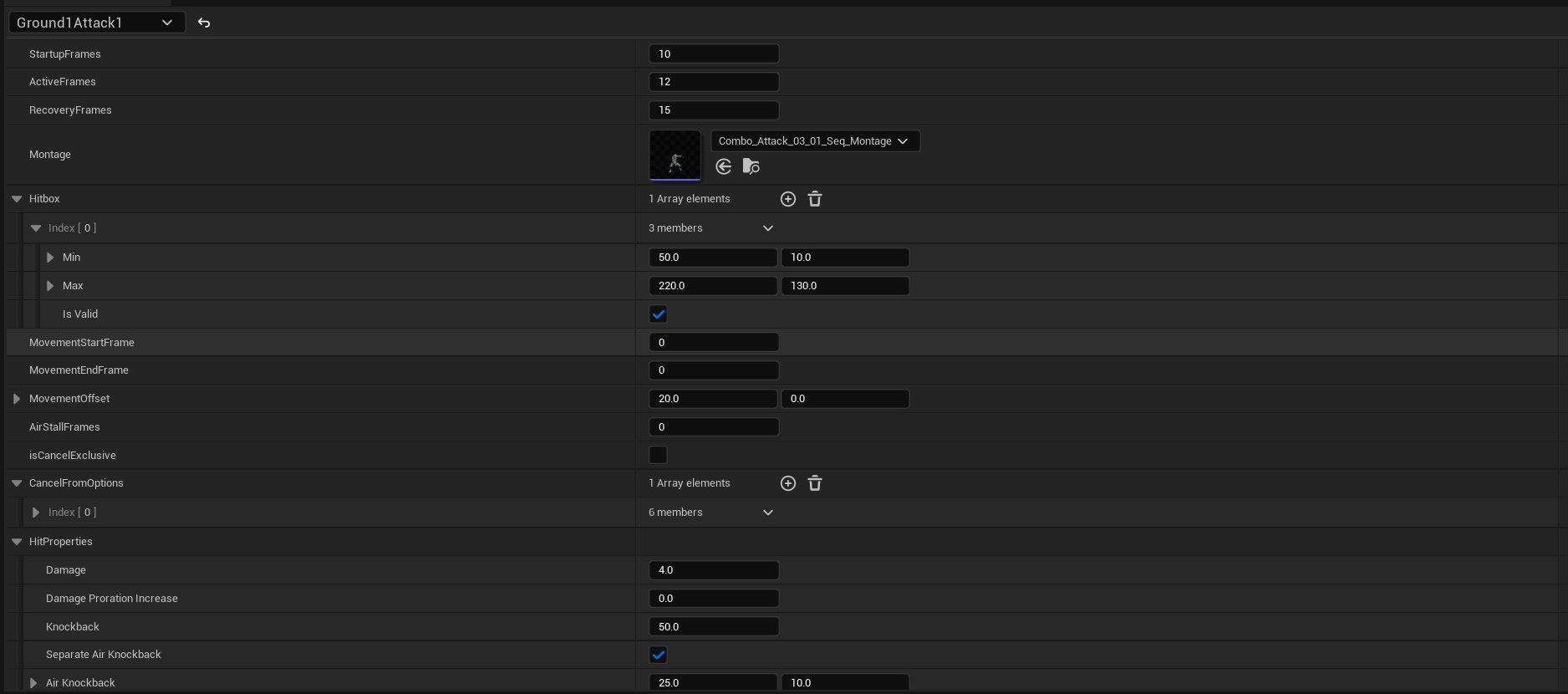
As the project continued, I requested that our Unreal Engine Project to be outfitted with a data table that allows for more efficient editing of attack data in-game, as well as serving as a replacement for the previous spreadsheet. This data table included ways to edit everything the spreadsheet had and more, while also allowing it to be edited for immediate changes in editor.
Alongside the spreadsheet, my other request for custom editing tools allowed for different segments of frames of attack animations to be tagged as either a part of the move’s startup, active, or recovery frames. After being tagged this way, when the animation was used for an attack, adjusting the wind-up time, active time, and recovery time would adjust how long those sections of the animation played for. While I was not in charge of the implementation of both of these features, commissioning them gave me a better impression of how to communicate with engineers and request for added features while also keeping them reasonable and providing plenty of detail.
Combo Theory and Animation Usage
Given our game’s status as a character action game, ensuring the game had a robust combo system was one of our highest priorities. Given my previous experience in developing and playing action games, I was tasked with construction of the player’s move list and how combos would be strung together. Due to our team lacking artists and animators, we used assets available on the UE store and then worked with what we were able to afford.
After purchasing an extensive animation pack of sword swings and other techniques, I was able to create a move list for the player that included all of the necessary staples for the genre, modified to fit into 2D gameplay. Despite our small move list only encompassing the basics, I was able to create an extremely variable and expressive combo system. I achieved this by including a variety of cancel options and extensively modified frame data and hitbox sizes in order to ensure the desired strings of attacks would work together.
The “baseline” combo I designed the system around was
3-hit light attack string>Launcher>Jump cancel>3-hit aerial light attack string>Dive attack. This basic combo could then be modified or extended given the other moves the game featured, including a dash attack, and a spinning multi-hit aerial move.
One crucial element that made the combo system work was the concept of combo decay, something I was intimately familiar with due to my previous experience in both playing and developing fighting games. In simple terms, this mechanic caused every attack dealt during a combo to launch the opponent lower, depending on how many hits had already occurred. I found the adjustment of this to be just as, if not more important than the adjustment of frame and hitbox data, as having scaling be too high or too low would result in combos either ending too soon or lasting far longer than they should.
I added depth to the combo system by doing more than just editing attacks, however. An issue we faced early on was enemies being destroyed by the player before they had a chance to finish their combo. To mitigate this, I designed the “Overkill” mechanic, in which if a player could further drain an enemy’s health into the negatives during a single combo up until enough damage was done to defeat them a second time, the player would be healed for however much excess damage they dealt. This not only solved the problem of combos being forced to end too early but also rewarded player skill in terms of their physical execution ability, as well as their knowledge of the combo system.
 May W. Games