SpellBank

- Platform: Pen & Paper
- Engine: Pen & Paper
- Development Time: 2 Weeks
- Team Size: 1
- Developer: Self
- My Role(s): Sole Developer
- Download Link: Pen and Paper Board + Rules
SpellBank is a PvP tabletop game in which players roll dice to choose from a list of “spells” they can use against their opponent. After the dice decide the list, the player then gets to select a damage and status spell to use against the opponent. The first player to reduce their opponent’s health to zero wins. The game was designed to be an experiment in how much a game could be based on RNG while still retaining player agency and allowing interesting decision-making. This game was designed as my first project for my system design class at DigiPen Institute of Technology and remains one of my favorite projects that I’ve worked on to this day.
As the sole developer of this project, my contributions to this project include:
- Creation of the game’s initial concept, as well as prototyping of assets and rules.
- All playtesting and playtest analyses.
- Fully drafting the game’s rule system, as well as designing every spell the game includes.
Growing From Humble Beginnings
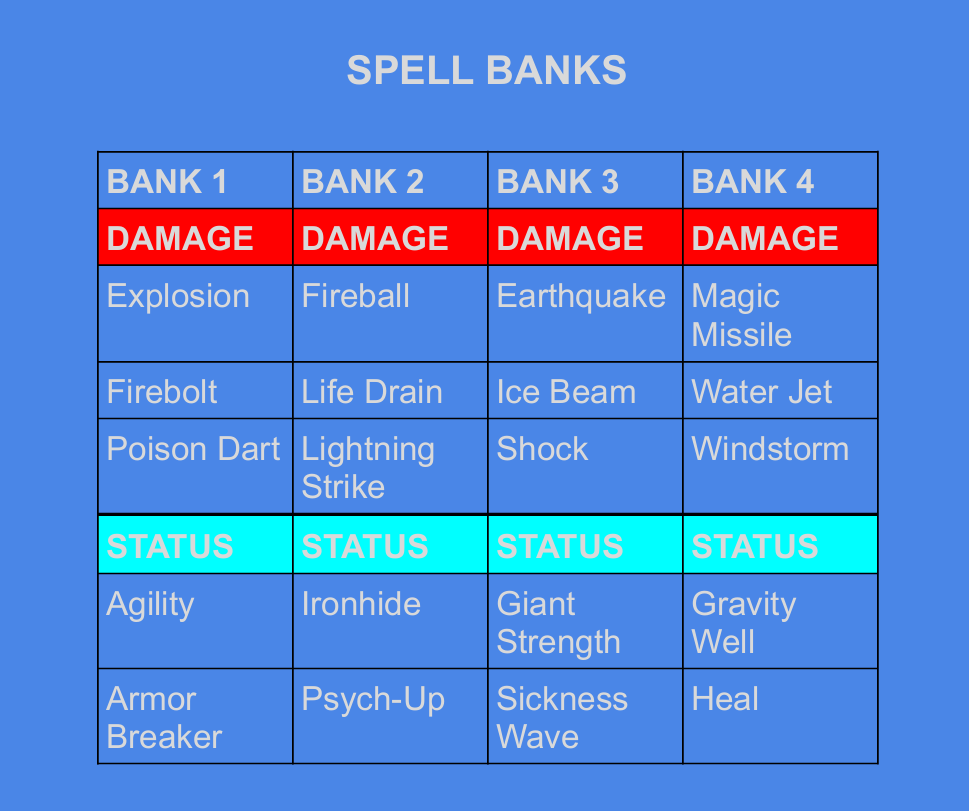
As mentioned above, this was the first system design project I had ever worked on and serves as a great baseline to compare my later projects to. I think the part of this design that speaks the most to my inexperience with game development at the time is its simplicity. Given that half of the game is controlled through RNG, players aren’t given a huge amount of choices to make, only being able to decide the spell they cast from the bank they rolled, and even then, the decisions made are fairly simple given the limited list of spells to choose from, the simplicity of the spells themselves, and the random outcomes they generate. While I still do believe that this game allowed for interesting decision-making, it’s still very limited. Looking back on it in retrospect, I probably could’ve introduced other avenues from which the player could have made decisions, such as the ability to choose which spells are a part of which bank before a match, and both players having their own separate banks.

A solid element of this game’s design philosophy that I believe still shows (and was improved on) in my later projects is my ability to blend a project’s influences, while also elaborating on them in ways that make sense for the project. SpellBank‘s combat was heavily based on that of 5th edition Dungeons & Dragons, specifically regarding the mechanics and balancing of spell casting. I was inspired by the way 5E used a variety of different dice in different quantities alongside a flat base damage applied to it. I built on this concept by using the base damage bonus as an extra way to balance the damage of specific spells (some spells may have higher max damage due to the dice used, but a lower base damage due to the flat number added), as opposed to it being a stand-in value for the player’s level of strength. This a strength that I’ve improved on throughout my later projects, as I typically wear my inspirations on my sleeve, but can recontextualize them to fit the project’s overall vision.
 May W. Games